


At Natan Medvedev’s wedding last week, he caused more than a ripple of laughter when, as the rabbi asked him to sign the ketubah—the Jewish marriage contract—he looked up and joked that he wasn’t sure he was ready to commit.
Laughing along with the crowd was Natan’s winsome bride, Rima.
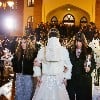
That’s because Medvedev is 92-years-old, and he has been civilly married to Rima for over six decades. But it was only on Tuesday, May 5, on the holiday of Lag BaOmer, that the couple were finally married according to Jewish law, along with four other couples at the Chabad-Lubavitch Beit Menachem center in Kyiv, Ukraine.
“A traditional Jewish wedding,” explains Chabad.org’s Jewish wedding section, “is a tapestry woven from many threads: biblical, historical, mystical, cultural and legal … carried from one generation to the next, forming a chain of Jewish continuity going back more than 3,800 years… The rituals and traditions of the Jewish wedding derive from both its legalistic particulars and its underlying spiritual themes—the body and soul of the Jewish wedding.”
For those who grew up in the former USSR, decades of Soviet persecution under Communism meant that practicing Judaism, including having a Jewish wedding and educating children in the ways of the Torah, was forbidden. Many Jews of that generation were told by their parents to marry Jewish, but knew little of what that actually meant or how to get married according to Jewish law even after the Iron Curtain fell.

The Medvedevs, along with their friends Alexander and Inna Zaitzev and Michael and Tamara Gorni, are regular participants in Kyiv’s Beit Menachem Jewish community. The Chabad-Lubavitch synagogue and center is led by Rabbi Yonatan Markovitch, who spoke with them about the significance of formalizing their unions under Jewish law.
Inspired to walk under the chuppah, the three couples said they would have a joint celebration when the war raging between Russia and Ukraine was over. They wanted to celebrate this proud Jewish tradition freely, without air raid sirens or the constant shadow of danger. At the beginning of the Jewish year, they chose Lag BaOmer as the date for the happy celebration, hoping the war would be done and finished by then.

The war might not have been over, but by Divine Providence, the date did line up with a ceasefire in the conflict, and they were able to celebrate without the constant stress that has dominated their lives for the past four years. And so it was that last week, on Lag BaOmer, the three elderly couples finally stood under the chuppah, according to “the tradition of Moshe and Israel.” Two younger couples whose wedding plans had been delayed by the war joined them in getting married, before 60 members of the community.
Members of the community had each been asked to bring a gift. One contributed the wedding rings. Another brought towels and linens. Someone else arrived with whiskey. After the ceremony, one of the brides commented that the religious ceremony had moved her more deeply than her original secular one had decades earlier.
“It was a very special day that spoke to the strength and continuity of the Jewish people,” Rabbi Ariel Markovitch, associate rabbi at Beit Menachem, told Chabad.org. “These couples grew up without the opportunity to learn about their heritage, and now, for some over six decades later, we celebrated a proud Jewish wedding. The Jewish joy and spirit will always prevail.”




Start a Discussion